ChatFrom vs Chatbase: price, models and hosting
ChatFrom or Chatbase? Here is how the two compare on price, AI models, channels, tools and where your data is kept.
ChatFrom and Chatbase are built for the same job: a chatbot that answers your customers from your own documents and website. They also charge in the same way, with a monthly plan of credits. The difference is how far those credits go. Chatbase's Standard plan is $150 a month, or $120 a month billed yearly, for 4,000 message credits. ChatFrom's Pro plan is $29 a month for 7,000 credits, which is about 7,000 answers on GPT-6 Luna, the default model.
For a chatbot that handles 1,000 conversations a month, with three answers in each, that works out at $120 a month on Chatbase and $29 on ChatFrom. Chatbase is the better choice if you want the widest choice of AI models, answers on Messenger, Instagram or the phone, or a chatbot without branding. ChatFrom suits businesses that want a lower bill that does not move, tools like Shopify and Stripe on every plan, and their data kept in Germany. I make ChatFrom, so I have tried to be clear about where Chatbase is ahead.
Two products for the same job
Both are chatbot builders. You add your documents, your website and your own answers, and the chatbot answers on your website and in chat apps. Chatbase calls its chatbots agents, and from the Standard plan it also includes a help desk, where your team can take over a conversation.
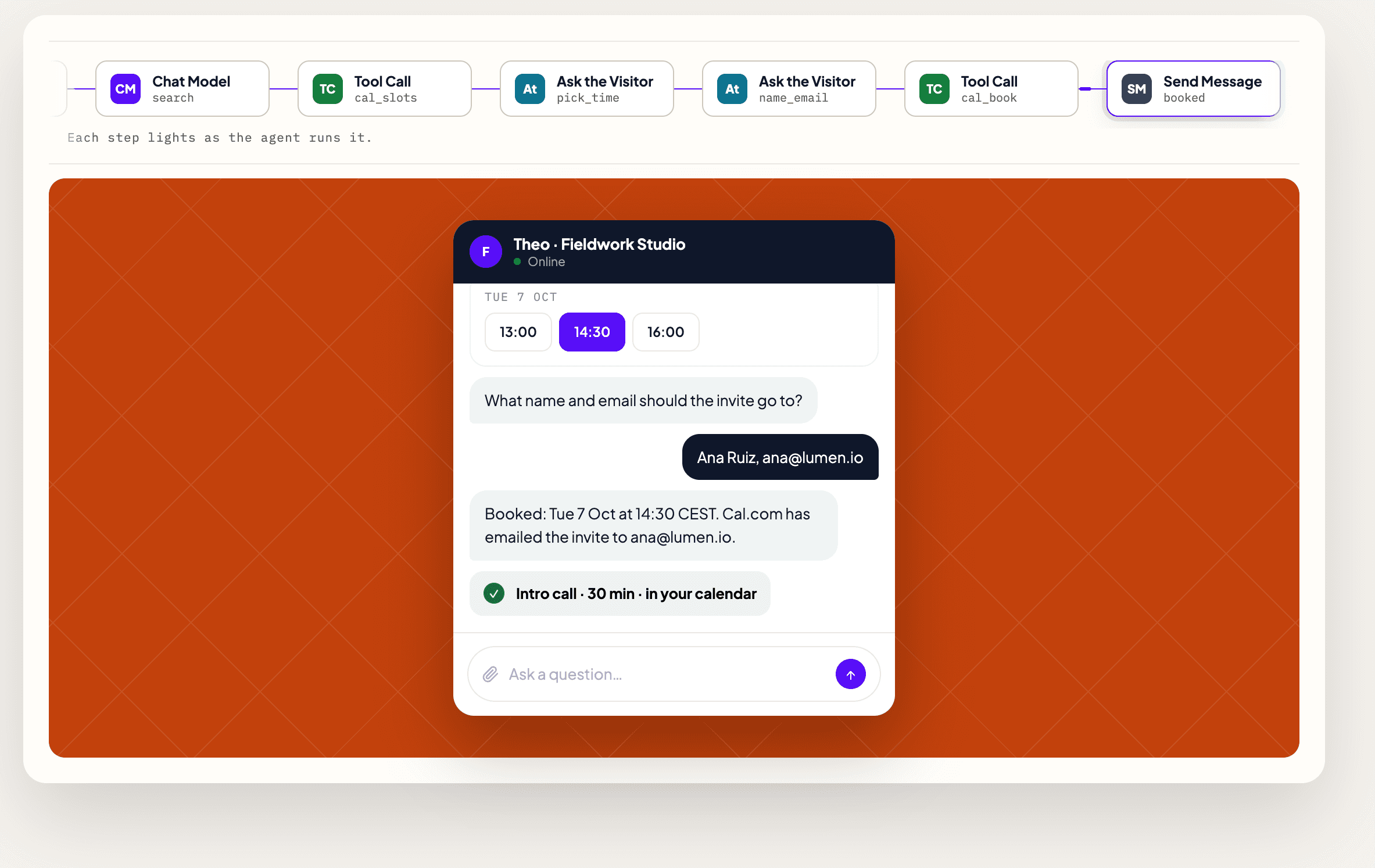
ChatFrom has no inbox of its own. When a person is needed, it hands the conversation to your team by email or Slack, or into your Crisp chatbox. It puts more into what the chatbot can do by itself instead: a workflow canvas for tasks with several steps, and built-in tools for orders, subscriptions, bookings and leads. Its engine, the part that writes the answers, is open source.
How each one charges
On paper the two charge alike, since both sell monthly credits. In practice they count them very differently:
| Chatbase | ChatFrom | |
|---|---|---|
| What you pay for | A monthly plan of message credits | A monthly plan of answer credits |
| Price | Hobby $40, Standard $150 and Pro $500 a month, or $32, $120 and $400 billed yearly | Hobby $0, Pro $29 and Business $49 a month |
| Credits a month | 700, 4,000 or 15,000 | 50, 7,000 or 20,000 |
| Credits per answer | 1 to 5, set by the model; an answer that uses an action can cost twice | What the model cost, at $0.001 a credit, and at least 1 |
| Chatbots | 1 per plan; each extra one is $25 a month | As many as you like |
| Seats | 2, 3 or 5 | 1 |
| When the credits run out | The agent stops, unless auto-recharge is on, at $40 per 1,000 credits | The chatbot pauses until the month resets; nothing is charged past the plan |
| Free plan | Not on the pricing page; its docs mention 50 credits a month, and an unused agent is deleted after 14 days | Hobby: 50 credits a month, no card; conversations are deleted two weeks after their last message |
| Removing the branding | $99 a month | Not offered |
Yes, both have a plan called Hobby, but they are not alike: Chatbase's Hobby is its $40 entry plan, and ChatFrom's Hobby is free.
The bigger difference is what a credit is worth. Chatbase gives each model a fixed number of credits per answer, from one for GPT-6 Luna to five for Claude 5.5 Opus. ChatFrom charges what the answer actually cost the model, so a stronger model uses more of its credits. But a ChatFrom credit is $0.001, while a Chatbase credit on a fully used Standard plan costs about $0.03. The figures are on Chatbase's pricing page and in its docs on models.
What a month costs
To compare the bills, I assumed three answers per conversation and took the cheapest way to cover them on each side. On Chatbase, that is sometimes a plan plus extra credits at $40 per 1,000. I also used Chatbase's yearly prices, which are 20% lower than paying month to month. ChatFrom is only billed monthly.
| Conversations a month | Answers | Chatbase, billed yearly | ChatFrom |
|---|---|---|---|
| 100 | 300 | Hobby, $32 | Pro, $29 |
| 500 | 1,500 | Hobby plus 1,000 credits, $72 | Pro, $29 |
| 1,000 | 3,000 | Standard, $120 | Pro, $29 |
| 1,500 | 4,500 | Standard plus 1,000 credits, $160 | Pro, $29 |
| 3,000 | 9,000 | Standard plus 5,000 credits, $320 | Business, $49 |
| 4,500 | 13,500 | Pro, $400 | Business, $49 |
At very small volumes, the two cost about the same. A hundred conversations a month fit in Chatbase's Hobby plan at $32, and ChatFrom's Pro is $29. ChatFrom's free Hobby plan only has 50 credits, which is about 16 conversations, so it is for trying ChatFrom out rather than running it.
From there, the gap grows. At 1,000 conversations, Chatbase needs Standard at $120, while ChatFrom still fits in Pro at $29. At 3,000 conversations, Chatbase comes to $320 with extra credits, and ChatFrom moves to Business at $49. On a stronger model such as GPT-6.1 Sol, 1,000 conversations cost $200 on Chatbase and $49 on ChatFrom.
ChatFrom does have a ceiling, though. Business covers about 6,700 three-answer conversations a month on the default model, and past that your chatbot pauses until the month resets. Chatbase keeps answering for as long as you keep buying credits.
The models you can choose
Both let you choose the AI model for each chatbot. This table shows the credits one answer uses on each model, and what 1,000 conversations a month would cost on each side:
| Model | On Chatbase | On ChatFrom |
|---|---|---|
| GPT-6 Luna | 1 credit, $120 | 1 credit, $29 on Pro |
| Claude Haiku 5.5 | 1 credit, $120 | 1 credit, $29 on Pro |
| Gemini 3.5 Flash-Lite | Not listed | 1 credit, $29 on Pro |
| Mistral Large 4 | Not listed | 1.7 credits, $29 on Pro |
| GPT-6.1 Sol | 2 credits, $200 | 3.8 credits, $49 on Business |
| Claude Sonnet 5.5 | 2 credits, $200 | 5.1 credits, $49 on Business |
| Gemini 3.8 Flash | 2 credits, $200 | Not offered |
| GPT-5.5 | 4 credits, $400 | Not offered |
| Claude 5.5 Opus | 5 credits, $400 | Not offered |
Chatbase has more models, including its most capable ones, GPT-5.5 and Claude 5.5 Opus, and models from DeepSeek, Grok, Kimi and GLM. ChatFrom has six, from OpenAI, Anthropic, Google and Mistral. I measured ChatFrom's costs on 16 October 2026 against what OpenRouter billed, including the search steps around each answer.
For a chatbot that answers from your documents, finding the right passage usually matters more than the model. But if you want the most capable models, Chatbase has them and ChatFrom does not.
Where it can answer
Chatbase reaches more of the big consumer apps, and it has kits for iOS and Android apps. ChatFrom has a few channels that Chatbase does not list, such as Telegram, Discord and the Crisp chatbox.
| Channel | Chatbase | ChatFrom |
|---|---|---|
| Website chat | Yes, a chat bubble, a help page or an iframe | Yes, a widget added with one script tag, and a share link |
| Yes | Yes, from the chatbot's own address, which your inbox can forward to | |
| Yes | Yes | |
| Slack | Yes | Yes |
| Messenger and Instagram | Yes | No |
| Phone | Yes | No |
| iOS and Android apps | Yes, with its SDKs | No |
| Help desks | Zendesk and Salesforce | Hand-off by email, Slack or into Crisp |
| Telegram | Not listed | Yes |
| Discord | Not listed | Yes |
| Crisp chatbox | Not listed | Yes |
Chatbase's list is on its channels page. On cost, the channel makes no difference on either: an answer uses the same credits wherever it is given.
What it learns from
| Source | Chatbase | ChatFrom |
|---|---|---|
| Files | PDF, TXT, DOC and DOCX, up to 20 MB each | PDF, plain text, Markdown and HTML |
| Your website | Yes, by crawling, from a sitemap or page by page | Yes, with the pages you tick |
| Text and Q&A | Yes | Yes |
| Notion | Yes | No |
| Google Docs | Not listed | Yes |
| Help desk tickets | Closed tickets from Zendesk or Salesforce | No |
| Sources shown under answers | Not documented | Yes |
Chatbase reads more kinds of sources, including Notion pages, Word files and old support tickets. ChatFrom reads Google Docs, which Chatbase's docs do not list, and shows the source under every answer, so a customer can see where it came from. Chatbase's list is in its docs on data sources.
Tools and actions
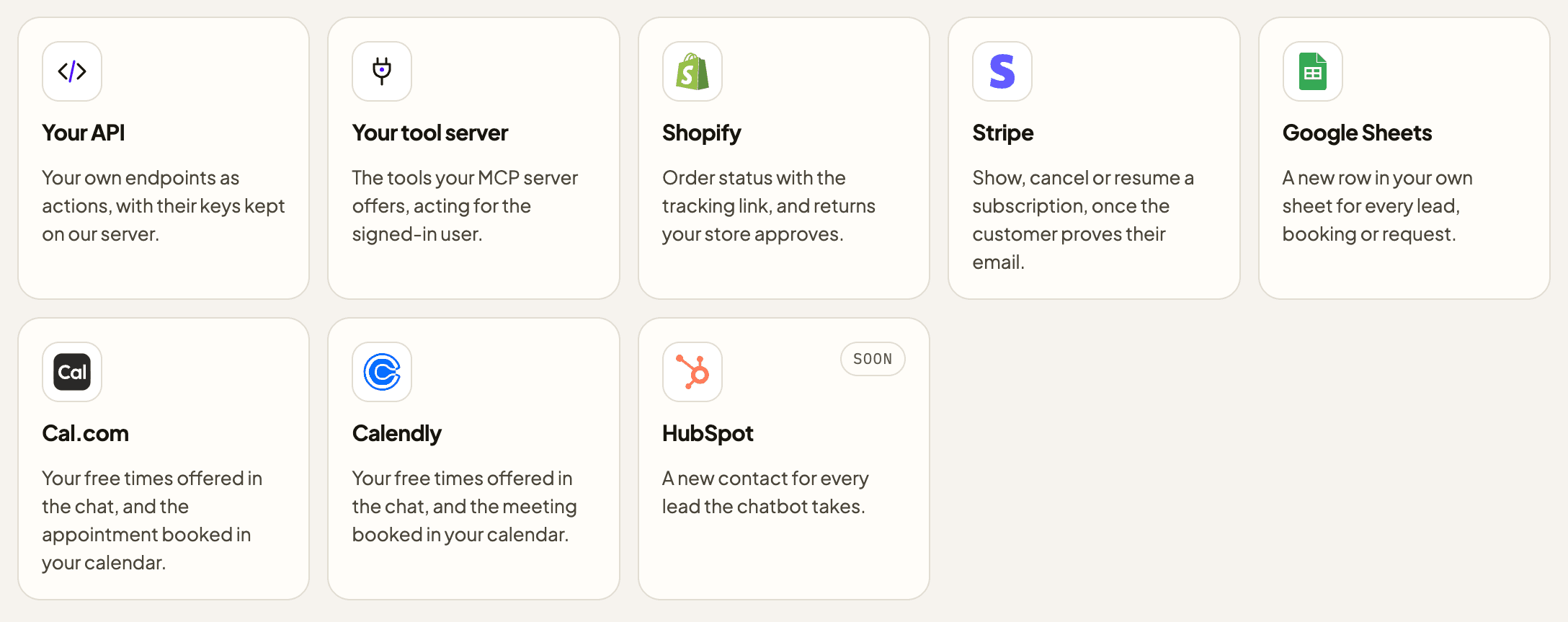
Both can do more than answer. Chatbase has actions for Shopify, Stripe, Cal.com and Calendly, can call your own API, and can hand a conversation to a help desk. Its Stripe actions start on the Standard plan, at $150 a month. For tasks with several steps, Chatbase uses procedures: steps with if and else, written out rather than drawn.
ChatFrom's tools are built in on every plan, and you switch them on with a key or a sign-in. It can look up a Shopify order and request a return, manage a Stripe subscription once the customer proves their email, add a row to a Google Sheet, book a meeting in Cal.com or Calendly, and take call-back requests. For anything else, it calls your own API or an MCP server. Tasks with several steps are drawn on a workflow canvas, one box per step.
Both can also be set up from an AI agent such as Claude Code, through an MCP server: ChatFrom's with an API key, and Chatbase's with an OAuth sign-in. On cost, a tool call is part of an answer on both, and uses its credits.
Where the data is
- ChatFrom runs its app, its engine and its database in Frankfurt, Germany, on every plan. The AI models run at their makers, mostly in the United States, and each call goes only to the maker of its model. On the free Hobby plan, conversations are deleted two weeks after their last message.
- Chatbase runs on AWS in the United States (us-east-1) by default. A choice of data region is part of its Enterprise plan.
For a business in Europe, that means ChatFrom keeps its data in Germany at $29 a month. On Chatbase, hosting in the EU needs the Enterprise plan.
What ChatFrom does not do
These gaps are real, and for some businesses they will decide the choice:
- Fewer models. ChatFrom has six. Chatbase also offers GPT-5.5, Claude 5.5 Opus and Gemini 3.8 Flash, and models from DeepSeek, Grok, Kimi and GLM.
- No help desk. A hand-off goes to your team by email or Slack, or into your Crisp chatbox. Chatbase includes a help desk from its Standard plan.
- No Messenger, Instagram, phone or mobile app kits. If your customers reach you there, Chatbase covers them and ChatFrom does not.
- No white label. Every ChatFrom plan shows a small "Powered by ChatFrom" line. Chatbase removes its branding for $99 a month.
- One person per account. Several people cannot share a ChatFrom account yet. Chatbase's plans include two to five seats.
- A hard stop at the plan's credits. That keeps the bill fixed, but a busy month can end with your chatbot paused until the credits reset or you upgrade.
- Fewer knowledge sources. No Notion, Word files or help desk tickets.
- A young product. ChatFrom comes from a small studio, and Chatbase has been running for longer, with far more customers.
Common questions
How much does Chatbase cost?
Hobby is $40 a month for 700 message credits, Standard is $150 for 4,000, and Pro is $500 for 15,000. Paying yearly brings them down to $32, $120 and $400 a month. Each answer uses one to five credits, depending on the model. Those were the prices on 18 October 2026.
Is ChatFrom cheaper than Chatbase?
For most businesses, yes. With three answers per conversation, 1,000 conversations a month cost $120 on Chatbase, billed yearly, and $29 on ChatFrom Pro. On a stronger model such as GPT-6.1 Sol, they cost $200 and $49. At around 100 conversations a month, the two cost about the same.
Does Chatbase have a free plan?
Not on its pricing page, which offers a 7-day trial on each paid plan instead. Its docs do mention a free plan with 50 message credits a month, where an agent you do not use is deleted after 14 days. ChatFrom's Hobby plan is free, with 50 credits a month and no card.
What happens when the credits run out?
On Chatbase, the agent shows "This AI Agent is currently unavailable" until the credits renew, unless you have turned on auto-recharge at $40 per 1,000 credits. On ChatFrom, the chatbot pauses until the month resets, or until you move to a larger plan, and nothing is charged past the plan.
Which one keeps data in the EU?
ChatFrom keeps its app, engine and database in Frankfurt on every plan, while the AI models run at their makers. Chatbase runs in the US by default, and offers a choice of region on its Enterprise plan.
Verdict
| If you want | Choose | Why |
|---|---|---|
| The widest choice of AI models | Chatbase | Eight model makers, including GPT-5.5 and Claude 5.5 Opus. |
| Answers on Messenger, Instagram, the phone or in your own app | Chatbase | ChatFrom does not answer on these channels. |
| No branding, or a team sharing one account | Chatbase | Branding removal is $99 a month, and its plans include two to five seats. |
| A lower bill for the same answers | ChatFrom | 1,000 conversations a month cost $29 on Pro, against $120 on Chatbase Standard billed yearly. |
| Shopify, Stripe, Google Sheets and bookings on every plan | ChatFrom | They are built in; Stripe on Chatbase starts at Standard, $150 a month. |
| Telegram, Discord or Crisp | ChatFrom | Chatbase does not list them. |
| Hosting in the EU without an Enterprise plan | ChatFrom | Frankfurt on every plan, from $0. |
If you are already on Chatbase and happy with it, the main reason to move is cost. For the same 1,000 conversations, the bill drops from $120 to $29 a month. If you rely on its wider choice of models, on Messenger, Instagram or the phone, or on a chatbot without branding, Chatbase is still the better fit.
If you are choosing for the first time, I think ChatFrom is the better fit for most small businesses, mostly because of the price, and also for the built-in tools and the hosting in Germany. Either way, try both with your own questions before you decide. There are more comparisons on the compare page, and all the plans are on the pricing page.
ChatFrom builds a chatbot from your documents and website, for your site, chat apps and email, with bookings, orders and subscriptions built in. You can start on the free Hobby plan, with no card, and compare its answers with your current chatbot.